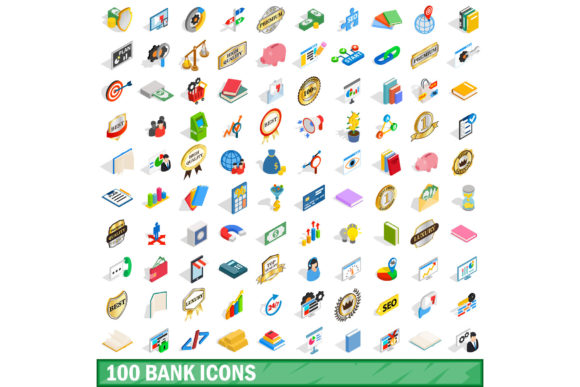
Transforming Financial Design: The Power of a 100 Bank Icons Set in Isometric 3D Style
In the rapidly evolving landscape of digital design, visual clarity is not just an aesthetic choice; it is a functional necessity. When users interact with banking apps, fintech platforms, or financial dashboards, they need to process information instantly. This is where high-quality iconography becomes the backbone of user experience (UX). Among the various styles available, the 100 Bank Icons Set, Isometric 3D Style has emerged as a premium resource for designers seeking to add depth, modernity, and professionalism to their projects. Unlike flat, two-dimensional symbols, isometric icons provide a tangible sense of space and structure, making complex financial concepts feel more accessible and engaging.
The demand for sophisticated visual assets has never been higher. Whether you are designing a mobile wallet interface, a corporate annual report, or a marketing landing page for a new cryptocurrency exchange, the right visual language can significantly impact conversion rates and user trust. A comprehensive collection like the 100 bank icons set in isometric 3d style offers a versatile toolkit that bridges the gap between technical data and human-centric design. By providing a unified visual vocabulary, these icons ensure consistency across your entire brand ecosystem, from web applications to print materials.
Why Isometric Design Resonates in Fintech
To understand the value of this specific asset pack, one must first appreciate the psychological impact of isometric design. Isometry refers to a method of graphical representation in which three-dimensional objects are drawn so that all three axes appear equally foreshortened. In simpler terms, it creates a 3D look without the distortion of perspective. For the finance industry, this style is particularly effective because it conveys stability, precision, and complexity—all traits that consumers associate with secure banking services.
Traditional flat icons can sometimes feel sterile or abstract. They represent ideas but lack physical presence. An isometric icon, by contrast, feels like a miniature object sitting on your screen. It invites interaction. When a user sees a 3D representation of a vault, a credit card, or a growing graph, their brain processes it differently than a simple line drawing. It triggers a sense of realism and reliability. This is crucial in fintech, where trust is the primary currency. A well-executed 100 Bank Icons Set, Isometric 3D Style leverages this psychological advantage to make financial tools feel less intimidating and more user-friendly.
Furthermore, the trend toward "spatial computing" and augmented reality interfaces means that 3D elements are becoming standard in modern UI/UX design. Early adoption of isometric styles positions a product at the forefront of design trends, signaling to users that the platform is innovative and forward-thinking. This subtle cue can be the difference between a user feeling comfortable with their money and feeling uneasy about the technology handling it.
Comprehensive Coverage for Every Financial Need
One of the most significant advantages of purchasing a pre-made set like the 100 bank icons set in isometric 3d style is the breadth of coverage. Financial ecosystems are vast, encompassing everything from basic savings accounts to complex derivatives trading. Creating unique icons for every single function within a banking app is time-consuming and often results in inconsistent styling. A curated set solves this problem by providing a cohesive library that covers the full spectrum of banking activities.
Imagine you are building a dashboard for a neo-bank. You need icons for:
- Transactions: Transfers, payments, refunds, and withdrawals.
- Accounts: Checking, savings, investment portfolios, and loans.
- Security: Biometric login, encryption shields, and fraud alerts.
- Analytics: Spending charts, income growth, and budget tracking.
- Services: Customer support, branch locations, and card management.
A set containing 100 distinct icons ensures that you have specialized symbols for each of these categories without needing to commission custom illustrations for minor details. This variety allows designers to maintain narrative coherence while addressing specific user needs. For instance, using a specific isometric icon for "International Transfer" versus "Local Payment" helps users quickly distinguish between transaction types, reducing cognitive load and potential errors.
Technical Versatility and Workflow Integration
Modern design workflows require flexibility. Designers often work across multiple platforms, collaborating with developers, marketers, and stakeholders who may use different software. The availability of the 100 Bank Icons Set, Isometric 3D Style in multiple formats—specifically JPG, EPS, AI, PSD, and PNG—makes it an incredibly robust asset for any professional team.
Let’s break down why these formats matter in a practical workflow:
- AI and EPS (Vector Formats): These are essential for scalability. If you need to take an icon from a small mobile app button and scale it up for a large billboard advertisement, vector formats ensure the lines remain crisp and the shading remains smooth. The isometric lighting effects do not pixelate or blur when resized. This is critical for maintaining brand integrity across all marketing channels.
- PSD (Photoshop Document): For designers who rely on layer-based editing, PSD files offer granular control. You can adjust shadows, highlights, and colors to match your specific brand palette. If your brand uses a deep blue instead of the default navy in the set, you can tweak the layers directly. This level of customization ensures the icons don't just fit the project; they become part of the brand identity.
- PNG (Raster Format): PNGs with transparent backgrounds are perfect for quick integration into web designs, presentations, or social media graphics. They are ready-to-use, requiring no additional processing, which speeds up turnaround times for urgent projects.
- JPG (Raster Format): While less flexible than PNGs due to compression, JPGs are useful for embedding in documents or low-bandwidth environments where file size is a concern.
This multi-format approach eliminates bottlenecks. A developer can grab a PNG for immediate implementation, while a lead designer can open the AI file to refine the aesthetics before final handoff. This interoperability streamlines the production pipeline, allowing teams to focus on strategy rather than asset conversion.
Strategic Considerations for Implementation
While having access to a rich library of icons is beneficial, successful implementation requires strategic planning. Not every icon should be used, and not every screen needs a 3D element. Overusing isometric icons can lead to visual clutter, distracting users from the core content. The key is balance. Use these icons to highlight key actions or to break up dense blocks of text. For example, in a "How It Works" section of a lending page, three large isometric icons representing "Apply," "Approve," and "Fund" can guide the user through the process intuitively.
Another consideration is color harmony. Isometric designs rely heavily on light and shadow to create depth. Ensure that the base colors of your icons align with your overall UI color scheme. Most professional sets allow for easy recoloring, but starting with a palette that complements your existing design system will save hours of adjustment time. Additionally, consider the context of use. On dark mode interfaces, isometric icons may need adjusted brightness levels to ensure they stand out against the background without losing their 3D definition.
Accessibility is also a factor. While 3D icons are visually appealing, they must still convey meaning clearly. Avoid overly complex designs that might be difficult for users with visual impairments to interpret. Stick to clear, recognizable metaphors. The 100 bank icons set in isometric 3d style typically includes intuitive representations, but always test your interface with real users to ensure that the visual cues are understood correctly.
Conclusion: Elevating Financial Communication
In a market saturated with digital financial products, differentiation is key. Visual excellence is one of the most effective ways to stand out. Investing in a high-quality 100 Bank Icons Set, Isometric 3D Style is not merely about acquiring graphics; it is about investing in user trust, engagement, and brand perception. By leveraging the depth and detail of isometric design, combined with the technical versatility of multi-format files, designers can create financial experiences that are not only functional but also delightful to use.
Whether you are a startup launching a new neobank or an established enterprise updating its legacy systems, these icons provide the building blocks for a modern, trustworthy, and aesthetically pleasing digital environment. They transform abstract numbers and transactions into tangible, understandable interactions, ultimately empowering users to manage their finances with confidence. In the world of fintech, where clarity equals credibility, the right visual assets are indispensable.