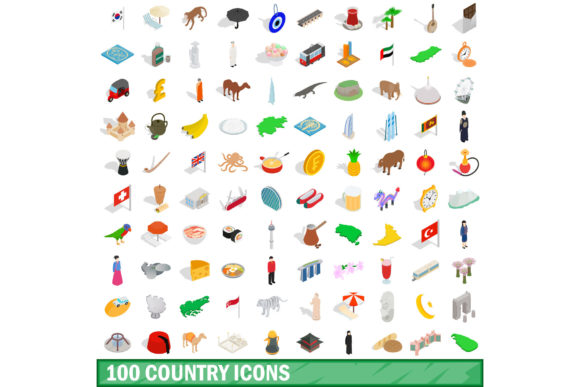
Elevating Global Identity: The Power of a Comprehensive 100 Country Icons Set in Isometric 3D Style
In the rapidly evolving landscape of digital design, visual communication has become the primary language of global interaction. Whether you are crafting a presentation for an international business summit, designing an educational app for geography enthusiasts, or creating a travel blog that captures the essence of wanderlust, the symbols you choose define the narrative. Among the most effective tools for this purpose is a 100 country icons set, specifically rendered in an engaging isometric 3D style. This comprehensive guide explores why this specific collection is indispensable for designers, educators, and content creators, and how it bridges the gap between flat data and immersive visual storytelling.
The Evolution of Iconography: From Flat to Three-Dimensional
To understand the value of a modern icon set, we must first look at the history of visual representation. For years, flat design dominated the digital world, prized for its simplicity and clean lines. However, as screens have become higher resolution and user expectations for depth and realism have grown, the limitations of two-dimensional graphics have become apparent. Enter the isometric 3D style.
Isometric projection is a method for visually representing three-dimensional objects in two dimensions. Unlike perspective drawing, which uses vanishing points to create depth, isometric drawings maintain parallel lines. This creates a unique aesthetic that feels both structured and dynamic. When applied to a set of country flags and national symbols, this style adds weight, texture, and presence to what was once merely a flat rectangle of color.
Consider the difference between a standard vector flag and an isometric version. A flat flag is functional but can feel sterile. An isometric flag, perhaps folded slightly or mounted on a stylized pole with subtle shadows, invites the eye to explore. It suggests tangibility. For any design vector illustration project, this added layer of complexity elevates the perceived quality of the entire composition.
Why a Set of 100? The Importance of Comprehensiveness
You might wonder why one would need a set containing exactly 100 countries rather than just the top ten most visited nations. The answer lies in inclusivity and scalability. In our interconnected world, audiences are diverse. A website targeting a European audience might need to represent Eastern European heritage; a logistics company shipping globally needs to acknowledge every region it serves.
- Global Inclusivity: A 100 country icons set ensures that no major nation is left out, fostering a sense of belonging for users from all backgrounds.
- Future-Proofing: Design projects often expand. Starting with a limited set may require a redesign later when new markets are targeted. A comprehensive set allows for seamless expansion without compromising visual consistency.
- Visual Balance: In infographics and dashboards, having a large pool of similar-styled icons helps maintain visual harmony. It prevents the "cluttered" look that occurs when mixing different artistic styles.
Furthermore, having a standardized set means that whether you are depicting Brazil, Japan, or Kenya, the lighting, angle, and detail level remain consistent. This uniformity is crucial for professional-grade vector illustrations where attention to detail signals credibility.
Technical Versatility: Formats That Fit Every Workflow
A high-quality asset is only as good as its usability. The true power of a premium 100 country icons set lies in its file format versatility. Designers rarely work in a single software environment, and clients may have varying technical requirements. This is why a robust set includes multiple formats: JPG, EPS, AI, PSD, and PNG.
Vector Formats: AI and EPS
For professional graphic designers, the AI (Adobe Illustrator) and EPS (Encapsulated PostScript) files are the gold standard. These vector formats allow for infinite scalability without loss of quality. You can take an isometric icon of a country and scale it up to the size of a billboard or down to the size of a favicon, and it will remain crisp. Additionally, because these files contain editable paths and layers, designers can customize colors, adjust the isometric angle, or integrate the icons into larger complex scenes.
Raster Formats: PNG and JPG
Not every user is a professional designer. Web developers, social media managers, and students often rely on raster images. PNG (Portable Network Graphics) files are particularly valuable because they support transparency. This allows the isometric icon to be placed over any background—be it a dark mode interface or a vibrant gradient—without an unsightly white box surrounding it. JPG files, while lacking transparency, offer smaller file sizes for web optimization, making them ideal for quick-loading thumbnails or background textures.
Layered Editing: PSD
The inclusion of PSD (Photoshop Document) files caters to those who prefer pixel-based editing. These files often come with smart objects and layered effects, allowing users to tweak shadows, highlights, and textures directly within Adobe Photoshop. This flexibility is essential for illustration projects that require a custom touch, ensuring the icons blend perfectly with other photographic or painted elements.
Practical Applications in Modern Life and Business
The utility of a 100 country icons set in isometric 3D style extends far beyond simple decoration. Let’s explore how this resource fits into various sectors.
Education and E-Learning
In the realm of education, engagement is key. Traditional textbooks often struggle to capture the imagination of younger learners. By using isometric 3D icons, educators can create interactive maps, quizzes, and flashcards that feel like games. Imagine a student dragging an isometric flag of France onto a map of Europe. The tactile feel of the 3D icon makes the learning process more memorable and enjoyable. These assets are perfect for creating educational materials that stand out in a crowded digital marketplace.
Corporate Branding and Presentations
Businesses operating on a global scale need to communicate their reach effectively. A slide deck showcasing international offices looks significantly more polished with a consistent set of 3D country icons than with a collage of low-resolution photos. These icons can be used in logos, brand guidelines, and marketing collateral to subtly reinforce a company’s global footprint. They convey professionalism and attention to detail.
Travel and Tourism
The travel industry thrives on aspiration. A travel agency’s website or brochure can use these icons to highlight destinations. An isometric icon of the Eiffel Tower integrated with the French flag, or a stylized representation of Australia, evokes a stronger emotional response than text alone. These visuals serve as quick, recognizable markers that help travelers identify their dream destinations at a glance.
Data Visualization and Infographics
When presenting statistics—such as population density, GDP, or tourism numbers—by country, using plain text labels can be dry. Replacing country names with their corresponding isometric icons transforms a boring chart into a visually engaging infographic. This technique, known as pictorial representation, aids in quick comprehension and retention of information.
Clarifying Misconceptions About Vector Illustrations
There is a common assumption among beginners that "vector" and "3D" are mutually exclusive concepts. Some believe that if an image looks three-dimensional, it must be a complex 3D render requiring heavy processing power. While true for photorealistic renders, isometric vector illustrations are cleverly designed to mimic depth using simple geometric shapes and gradients. This means they retain the lightweight, scalable nature of vectors while offering the visual richness of 3D. Understanding this distinction is vital for designers who want high-impact visuals without compromising website load times or print costs.
Another misconception is that buying a pre-made set limits creativity. On the contrary, a well-structured 100 country icons set provides a strong foundation. Because the files are typically layered and editable, you are not stuck with the default appearance. You can change the color palette to match your brand, add custom textures, or combine elements to create entirely new symbols. The set serves as a toolkit, not a cage.
Choosing the Right Asset for Your Project
When selecting a 100 country icons set, consider the following criteria to ensure it meets your needs:
- Consistency: Ensure all 100 icons share the same isometric angle, line weight, and shading style.
- Detail Level: Check if the icons include recognizable landmarks or if they are purely abstract representations. The best sets often balance national flags with iconic cultural symbols.
- File Organization: A well-organized folder structure with separate folders for each format (AI, EPS, PNG, etc.) saves hours of frustration during the design process.
- Licensing: Always verify the usage rights. Most commercial icon sets allow for unlimited use in personal and client projects, but some may restrict resale as standalone assets.
Conclusion
In a world driven by visual content, the small details make a big difference. A 100 country icons set in isometric 3D style is more than just a collection of graphics; it is a powerful tool for enhancing communication, education, and brand identity. By offering versatile formats like JPG, EPS, AI, PSD, and PNG, these assets integrate seamlessly into any workflow, from professional vector illustration studios to casual social media posts. Whether you are building a global brand, teaching the next generation, or simply adding a touch of sophistication to your designs, investing in a high-quality, comprehensive icon set is a decision that pays dividends in clarity, engagement, and aesthetic appeal. Embrace the depth of isometric design and let your visuals tell a truly global story.