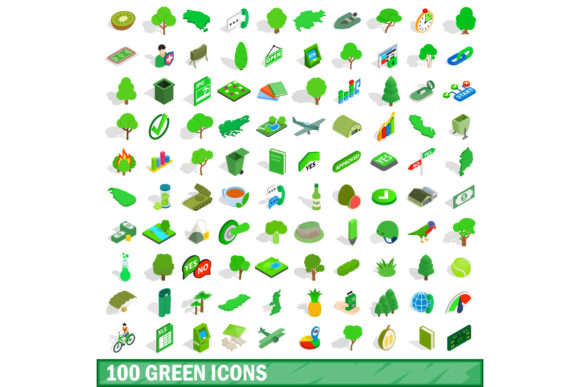
Evaluating the 100 Green Icons Set, Isometric 3d Style for Modern Design Projects
In the landscape of digital design, visual consistency and depth are critical for capturing user attention. Among the various aesthetic trends that have emerged, isometric illustration has established itself as a powerful tool for conveying complex information in a clean, organized manner. For designers seeking to incorporate this style into their workflows without compromising on thematic specificity, the 100 Green Icons Set, Isometric 3d Style presents a specialized resource. This collection offers a cohesive suite of assets designed to support projects ranging from environmental applications to sustainable technology interfaces.
Understanding whether this specific icon set aligns with your project requirements involves looking beyond surface-level aesthetics. It requires an evaluation of technical specifications, format versatility, and the broader context of isometric design trends. The following analysis explores the distinct characteristics of this set, compares it against alternative approaches, and provides practical guidance on when these assets are the optimal choice for your design needs.
Defining the Isometric Aesthetic in Iconography
Isometric design differs fundamentally from traditional flat or perspective-based illustration. It utilizes a method of graphical projection where parallel lines remain parallel, creating a three-dimensional effect on a two-dimensional plane. This approach eliminates vanishing points, resulting in a consistent scale across all objects. For icon sets, this means that every element—whether it represents a leaf, a recycling bin, or a solar panel—shares the same geometric logic and spatial relationship.
The 100 Green Icons Set, Isometric 3d Style leverages this geometry to create a unified visual language. The "green" theme suggests a focus on sustainability, nature, eco-friendly practices, or perhaps a specific color palette centered around verdant tones. By maintaining strict isometric rules, the set ensures that icons can be mixed and matched within dashboards, infographics, or mobile applications without breaking visual harmony. This consistency is often difficult to achieve when sourcing individual icons from disparate libraries, making pre-packaged sets like this one particularly valuable for large-scale UI/UX projects.
Technical Versatility and Format Options
A significant factor in evaluating any design asset is its technical flexibility. The availability of multiple file formats directly impacts how easily the icons can be integrated into different software environments and deployment pipelines. This set stands out by offering a comprehensive range of formats: JPG, EPS, AI, PSD, and PNG.
- Vector Formats (AI, EPS): These files are essential for scalability. If a designer needs to resize an icon from a small favicon to a large billboard print without losing quality, vector formats are non-negotiable. The inclusion of both Adobe Illustrator (AI) and Encapsulated PostScript (EPS) ensures compatibility across various vector editing tools, not just Adobe’s ecosystem.
- Raster Formats (PNG, JPG): PNG files typically offer transparency, which is crucial for overlaying icons on varied backgrounds. JPG files provide smaller file sizes for web optimization where transparency is not required. Having these pre-rendered saves time compared to exporting them manually from vector files.
- Layered Files (PSD): The inclusion of Photoshop (PSD) files allows for deeper customization. Designers can edit layers, adjust colors, or modify specific components of an icon before finalizing it. This level of control is vital when a brand requires slight deviations from the standard icon style to match unique guidelines.
This multi-format support reduces friction in the design workflow. It allows teams to use vectors for initial layout and prototyping, then switch to raster formats for final export, ensuring efficiency at every stage.
Comparing Isometric Sets Against Flat and Skeuomorphic Styles
When selecting iconography, designers often choose between flat design, skeuomorphism, and isometric styles. Each has distinct advantages and tradeoffs. Understanding where the 100 Green Icons Set, Isometric 3d Style fits helps in making a more informed decision.
Flat vs. Isometric
Flat design is characterized by minimalism, bold colors, and lack of depth cues. It is highly legible at small sizes and loads quickly on web pages. However, flat icons can sometimes struggle to convey complex interactions or hierarchical relationships between elements. Isometric icons, by contrast, provide a sense of volume and structure. They are particularly effective for illustrating processes, systems, or physical objects. While they may require slightly more screen real estate due to their detailed nature, they offer a richer narrative potential. For projects involving data visualization or complex service descriptions, the isometric approach often communicates more effectively than flat symbols.
Skeuomorphism vs. Isometric
Skeuomorphic design attempts to mimic real-world textures and materials, such as leather stitching or wood grain. While nostalgic, this style can feel dated and cluttered in modern digital interfaces. Isometric design achieves a form of realism through geometry rather than texture. It feels contemporary and structured, fitting well with modern tech aesthetics. The 100 Green Icons Set likely employs smooth gradients and clean shading typical of modern isometric art, avoiding the heavy texturing of skeuomorphism while still providing a tangible feel.
Best-Fit Use Cases for Green Isometric Icons
The thematic focus of "green" combined with the structural rigor of isometric design makes this set suitable for specific niches. Identifying these use cases helps determine if the asset aligns with your current project goals.
Environmental and Sustainability Dashboards
Applications focused on carbon footprint tracking, energy consumption monitoring, or waste management benefit greatly from clear, structured visuals. Isometric icons can represent meters, graphs, and physical infrastructure (like wind turbines or solar arrays) in a way that feels integrated into a dashboard environment. The green color palette reinforces the theme of ecology and growth, creating an intuitive user experience.
E-Commerce and Retail Interfaces
For online stores selling organic products, gardening supplies, or eco-friendly goods, isometric icons can enhance product categorization. Instead of generic shopping cart icons, designers can use isometric representations of baskets, leaves, or packaging. This adds a layer of sophistication and brand personality that flat icons might lack.
Infographics and Presentations
Static media, such as annual reports or pitch decks, often rely on isometric illustrations to break up text-heavy content. A set of 100 icons provides enough variety to illustrate diverse concepts—from renewable energy sources to community gardens—without requiring custom illustration work for each slide. The consistency of the set ensures that the final presentation looks polished and professional.
Evaluation of Tradeoffs and Limitations
No design asset is perfect, and recognizing the limitations of the 100 Green Icons Set, Isometric 3d Style is crucial for realistic expectations.
Customization Constraints: While the PSD files allow for editing, the core geometry of isometric icons is fixed. If a project requires a highly abstract or minimalist interpretation of a concept, the detailed nature of isometric art might be too busy. Conversely, if a brand guideline demands extreme simplicity, the depth and shading of these icons might conflict with the desired aesthetic.
Color Palette Rigidity: Although the set is described as "green," the exact shades used may not align perfectly with every brand's specific hex codes. Designers must be prepared to adjust the color profiles in their vector software. While this is a minor task, it is an additional step compared to using a fully customizable flat icon set where color changes are instantaneous.
Volume of Assets: With 100 icons, there is a risk of cognitive overload during selection. Not every icon may be relevant to a specific project. Designers need to curate the set carefully to avoid including extraneous elements that could clutter the interface or distract the user.
Decision Factors: When to Choose This Set
Choosing the right icon set depends on balancing aesthetic needs with technical constraints. The 100 Green Icons Set, Isometric 3d Style is a strong candidate when:
- Cohesion is Priority: You need a large number of related icons that share the same visual weight and perspective. Sourcing individual isometric icons from free libraries often results in mismatched styles.
- Thematic Relevance: Your project revolves around sustainability, nature, health, or growth, and you want the visual language to reinforce this message immediately.
- Workflow Efficiency: Your team requires multiple formats (vector and raster) to handle both print and digital deliverables without spending hours converting files.
- Depth is Required: Your UI or infographic needs to convey complexity or physical presence that flat icons cannot adequately represent.
Conversely, if your project prioritizes ultra-minimalism, rapid loading speeds on low-bandwidth connections, or a completely abstract visual identity, a flat or line-art icon set might be more appropriate. Additionally, if your brand colors are strictly monochromatic or do not include green, you would need to invest significant effort in recoloring the entire set, potentially diminishing the value of the pre-designed aesthetic.
Conclusion
The 100 Green Icons Set, Isometric 3d Style offers a robust solution for designers seeking to add depth and thematic clarity to their projects. Its strength lies in the consistency of its isometric geometry, the versatility of its file formats, and the strategic alignment of its green theme with growing interests in sustainability and natural design. By understanding its technical capabilities and comparing it against other stylistic options, designers can determine whether this set provides the necessary foundation for their creative vision. Ultimately, the decision rests on the specific communicative goals of the project and the desired balance between detail and simplicity.