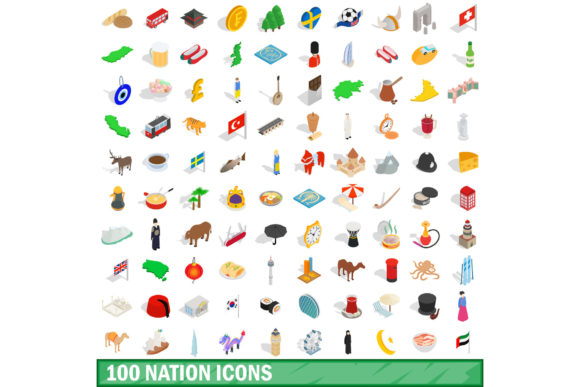
100 Nation Icons Set, Isometric 3d Style
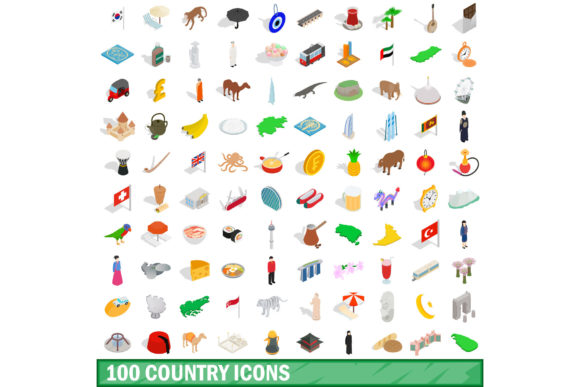
In the landscape of modern digital design, visual consistency is not merely an aesthetic preference; it is a functional requirement. When assembling complex projects—whether they are interactive dashboards, educational materials, or global marketing campaigns—the cohesion of visual elements directly impacts user comprehension and brand trust. This is where specialized asset libraries become critical infrastructure for creators. The 100 Nation Icons Set, Isometric 3d Style represents a targeted solution for professionals who require geographic representation that transcends flat, two-dimensional limitations while maintaining strict stylistic uniformity across large datasets.
Integrating this specific icon set into your workflow requires more than simply downloading files. It involves understanding the technical specifications, the strategic application of three-dimensional depth in user interface (UI) and user experience (UX) design, and the logistical management of vector assets. For designers, developers, and content strategists, mastering the use of these assets can significantly reduce production time while elevating the perceived quality of the final output.
Understanding the Isometric Advantage in Geographic Design
Traditional map icons often rely on flat silhouettes or simple line art to represent countries. While efficient, these formats can lack the visual weight needed to stand out in crowded interfaces or to convey a sense of tangible reality. The isometric projection offers a middle ground between abstract symbolism and realistic rendering. By using a fixed angle (typically 30 degrees) and parallel lines, isometric illustrations create a convincing illusion of depth without requiring perspective distortion.
When applied to national representations, this style allows for the inclusion of subtle details—such as topographical shading, architectural landmarks, or cultural motifs—without cluttering the overall shape. The 100 Nation Icons Set, Isometric 3d Style leverages this technique to provide distinct, recognizable markers for each nation. For a project manager overseeing a global expansion plan, having visually distinct yet stylistically identical icons ensures that stakeholders can quickly identify regions on a dashboard without being distracted by inconsistent artistic styles.
This approach is particularly effective in data visualization. When presenting demographic or economic data across multiple countries, the uniform height and perspective of the isometric icons help maintain a neutral baseline. The viewer’s eye is drawn to the data points rather than the varying complexities of the icons themselves, leading to faster processing of information and clearer decision-making pathways.
Technical Compatibility and Workflow Integration
The value of any digital asset library is heavily dependent on its compatibility with existing tools. A common friction point in creative workflows is the conversion of file formats, which can lead to loss of quality, broken layers, or increased file sizes. The inclusion of multiple formats—specifically JPG, EPS, AI, PSD, and PNG—in this set addresses this challenge head-on, allowing different team members to utilize the assets according to their specific roles within the production pipeline.
Vector Formats for Scalability and Editing
For graphic designers and UI/UX specialists, the availability of EPS and AI (Adobe Illustrator) files is paramount. These vector formats ensure that the icons remain crisp at any resolution, from mobile app icons to large-scale billboards. More importantly, they preserve editable paths and layers. If a marketing team needs to adjust the color palette to match a new brand guideline or modify a specific detail on a country’s icon, starting with the AI or EPS source files prevents the need to recreate the asset from scratch. This capability is essential for agile teams that iterate frequently based on feedback.
Similarly, PSD (Photoshop) files offer layered compositions that allow for advanced compositing. If a designer wishes to apply drop shadows, gradients, or texture overlays to integrate the icons seamlessly into a photorealistic background, the layered structure provided by the PSD files facilitates this process. It transforms the icon from a static image into a modular component that can be manipulated within a broader design system.
Raster Formats for Immediate Deployment
For web developers, front-end engineers, and social media managers, the PNG and JPG variants provide immediate usability. PNGs, with their support for transparency, are ideal for overlaying icons onto varied backgrounds without unsightly white boxes. JPGs, while lacking transparency, offer smaller file sizes suitable for contexts where alpha channels are unnecessary, such as embedded thumbnails or printed collateral previews. Having these pre-rendered options eliminates the bottleneck of exporting files manually, allowing non-designers to implement high-quality visuals quickly.
Strategic Implementation Across Project Lifecycles
The utility of the 100 Nation Icons Set, Isometric 3d Style extends across various stages of a project, from initial planning to final delivery. Understanding how to deploy these assets strategically can enhance efficiency and coherence.
- Pre-Production and Storyboarding: During the conceptual phase, designers can use the raster versions (PNG/JPG) to mock up layouts rapidly. This allows for quick validation of spatial arrangements and visual hierarchy before committing to heavy vector editing. It serves as a low-fidelity proofing tool that maintains high visual fidelity.
- Active Development and Creation: As the project moves into execution, the vector files (AI/EPS) become the primary working documents. Developers can extract SVG code directly from these sources for web implementation, ensuring accessibility and performance optimization. Designers can tweak colors and scales to align with responsive design breakpoints.
- Quality Assurance and Testing: In the testing phase, the variety of formats allows for cross-platform verification. An icon might look perfect in a desktop browser but render poorly on a smartwatch display. Having both vector and optimized raster versions enables testers to verify performance across different devices and resolutions, ensuring a consistent user experience.
- Archiving and Future Use: Properly organized asset libraries are crucial for long-term efficiency. Storing the original AI and PSD files alongside the exported PNGs creates a robust archive. If a future project requires a similar geographic theme, these assets can be reused, modified, or repurposed, reducing the need to commission new illustrations or search for compatible third-party packs.
Optimizing Efficiency Through Organization
One of the most overlooked aspects of using large icon sets is organization. A collection of 100 diverse items can quickly become chaotic if not structured logically. To maximize the utility of the 100 Nation Icons Set, Isometric 3d Style, users should adopt a systematic naming convention and folder structure. Grouping icons by continent or region can streamline the selection process during rapid prototyping. Furthermore, maintaining separate folders for each format (e.g., /vectors, /raster, /source) prevents accidental overwrites and simplifies version control.
Consistency in file naming—such as country_code_isometric.ai versus france_icon_final_v2_edited.png—reduces cognitive load when searching for specific assets. This discipline is particularly valuable for freelancers and small business owners who may juggle multiple clients and projects simultaneously. A well-organized asset library acts as a force multiplier, turning hours of potential searching into seconds of retrieval.
Considerations for Long-Term Viability
While the immediate visual appeal of isometric 3D icons is undeniable, practitioners should also consider the longevity of this style in design trends. Isometric illustration has maintained steady popularity due to its clarity and versatility. However, as design evolves, there may be a shift towards more minimalist or flat 2.5D styles. To future-proof your work, it is advisable to use the vector formats for core branding elements, as they can be easily deconstructed and simplified if the trend shifts away from heavy shading or depth. The ability to strip away layers and reduce complexity is a significant advantage of owning the source files over relying solely on flattened images.
Additionally, accessibility remains a critical factor. Isometric designs can sometimes obscure the outline of a shape, making it difficult for screen readers or users with certain visual impairments to distinguish one icon from another. When integrating these icons into digital products, always pair them with clear text labels or alt-text descriptions. The visual charm of the 3D style should enhance, not hinder, the usability of the interface.
Conclusion
The 100 Nation Icons Set, Isometric 3d Style is more than a decorative pack; it is a versatile toolkit designed to streamline the creation of professional, globally-aware visual content. By offering a comprehensive range of formats and adhering to a consistent isometric standard, it supports a wide array of workflows, from high-level strategic planning to granular technical implementation. For professionals seeking to elevate their visual communication with precision, scalability, and aesthetic depth, integrating this set into their resource library is a practical step toward more efficient and impactful design outcomes.