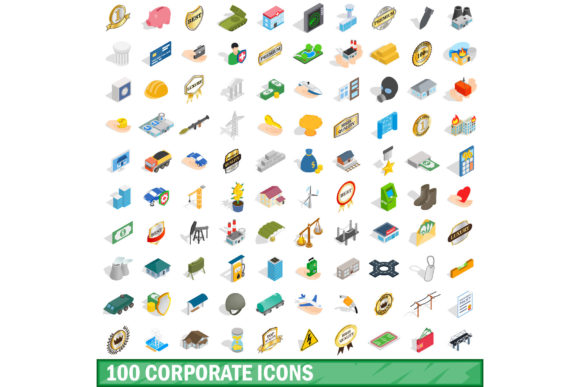
100 Corporate Icons Set: Elevate Your Design Projects
Visual communication is the backbone of modern digital interaction. Whether you are building a startup’s brand identity, creating an educational presentation, or designing a user interface for a mobile app, the right visual elements can make complex ideas instantly understandable. This is where a high-quality 100 Corporate Icons Set becomes an indispensable asset. It offers a curated collection of professional symbols designed to streamline your workflow and enhance the aesthetic appeal of your projects.
But not all icon sets are created equal. The market is flooded with generic clipart and low-resolution graphics that can make a design look dated or unprofessional. A premium set, particularly one that includes both standard flat icons and advanced 100 corporate icons set in isometric 3d style, provides depth, consistency, and versatility. These resources are crafted for anyone who needs to communicate business concepts clearly—be it finance, technology, human resources, or logistics.
Why Visual Consistency Matters in Professional Design
Inconsistency is the enemy of good design. When users encounter mismatched styles—such as mixing thick-line icons with thin-line ones, or combining 2D graphics with 3D models—it creates cognitive dissonance. It signals a lack of attention to detail. A cohesive 100 Corporate Icons Set solves this by providing a unified visual language. Every icon shares the same stroke weight, color palette, corner radius, and perspective.
This uniformity is crucial for branding. For entrepreneurs and small business owners, maintaining a professional image is often a matter of trust. Clients judge credibility within seconds. High-quality vector illustrations suggest that the company itself is polished and reliable. Furthermore, for freelancers and agencies, using a consistent icon library speeds up the design process significantly. Instead of spending hours drawing each symbol from scratch, designers can drag and drop pre-made assets that already fit the project’s style guide.
The Power of Isometric 3D Style
While traditional flat icons remain popular for their simplicity, there is a growing demand for depth and realism. This is where the 100 corporate icons set in isometric 3d style shines. Isometric design uses a specific type of parallel projection that gives objects a three-dimensional appearance without the distortion of perspective. It strikes a perfect balance between clarity and visual interest.
Isometric icons are particularly effective for explaining processes or systems. For example, if you are designing a dashboard for a logistics company, a 3D box with arrows pointing in different directions conveys movement and direction more intuitively than a simple arrow icon. Similarly, for tech startups, isometric servers, cloud storage units, or network nodes add a layer of sophistication that flat icons might lack.
This style appeals to a broad audience because it feels modern and dynamic. It works exceptionally well in:
- Landing Pages: To break up text-heavy sections and draw attention to key features.
- Infographics: To represent data points or hierarchical structures visually.
- Presentations: To make slides more engaging for educators and corporate trainers.
- Mobile Apps: Where screen space is limited, and every pixel must count towards user understanding.
Understanding the Formats: JPG, EPS, AI, PSD, PNG
One of the most critical aspects of any icon set is the file format provided. A comprehensive package should offer multiple formats to suit different workflows and software preferences. Here is why having access to JPG, EPS, AI, PSD, and PNG files is essential for creators at all levels.
Vector Files (AI, EPS)
For professional designers and developers, vector files are non-negotiable. Formats like EPS (Encapsulated PostScript) and AI (Adobe Illustrator) allow you to scale icons to any size without losing quality. You can resize a logo from the size of a postage stamp to a billboard, and the edges will remain crisp. These files are also editable, meaning you can change colors, adjust stroke widths, or combine shapes to create custom variations that match your specific brand guidelines.
Raster Files (JPG, PNG)
Not everyone works in Adobe Creative Cloud. Bloggers, marketers, and hobbyists often use tools like Canva, PowerPoint, or basic photo editors. For these users, JPG and PNG files are ideal. PNGs are especially useful because they support transparency, allowing icons to be placed over any background without a distracting white box around them. JPGs are great for quick previews or when file size needs to be minimized for web loading speeds.
Layered Files (PSD)
The inclusion of PSD (Photoshop Document) files adds another layer of flexibility. These files often contain layered groups, allowing users to isolate individual components of an isometric icon. If you need just the "gear" part of a "settings" icon, a PSD file makes it easy to extract that element without affecting the rest of the composition.
Practical Use Cases Across Industries
The versatility of a 100 Corporate Icons Set means it can be applied across various sectors. Let’s look at how different professionals might utilize these assets.
Entrepreneurs and Startups: When pitching to investors, clear visuals help explain your business model. Use isometric icons to illustrate your supply chain, customer journey, or revenue streams. A well-designed slide deck can be the difference between securing funding and being overlooked.
Educators and Trainers: In online courses or classroom presentations, icons serve as visual anchors. They help students remember key concepts. For instance, using a "book" icon for theory sections and a "lightbulb" icon for tips can guide learners through the material subconsciously.
Marketers and Content Creators: Social media posts require eye-catching visuals. A pack of 100 corporate icons provides endless possibilities for creating thumbnails, banners, and story highlights. Using consistent icons across platforms builds brand recognition.
Freelancers and Agencies: Efficiency is money. Having a ready-to-use library reduces production time. When a client requests last-minute changes, having editable vector files allows for rapid iteration without starting from zero.
Important Considerations Before Choosing an Icon Set
While the promise of 100 icons sounds appealing, it is important to evaluate the quality and relevance of the set before purchasing or downloading. Here are a few things to keep in mind:
- Relevance: Do the icons cover the specific industries you work in? A general corporate set might miss niche terms like "blockchain" or "telemedicine." Check the preview images to ensure the themes align with your needs.
- Style Cohesion: Ensure that the flat and 3D icons, if included in the same set, are stylistically compatible. Mixing incompatible styles can look messy unless used intentionally for contrast.
- Scalability: Always test the icons at small sizes. Some detailed 3D icons may lose clarity when shrunk down for mobile interfaces. Look for sets that include simplified versions for smaller applications.
- License Terms: Understand how you can use the icons. Most commercial licenses allow use in client projects, but some restrict resale or distribution of the raw files. Always read the fine print to avoid legal issues.
Conclusion
Incorporating a high-quality 100 Corporate Icons Set into your design toolkit is a smart investment for anyone looking to improve their visual communication. Whether you prefer the clean lines of flat design or the immersive depth of isometric 3d style, having access to versatile, professionally crafted vectors saves time and elevates the final product. By choosing a set that offers multiple formats like AI, EPS, PSD, PNG, and JPG, you ensure that you are prepared for any design challenge, big or small. Ultimately, the goal is to convey your message clearly and beautifully, and the right icons make that possible.