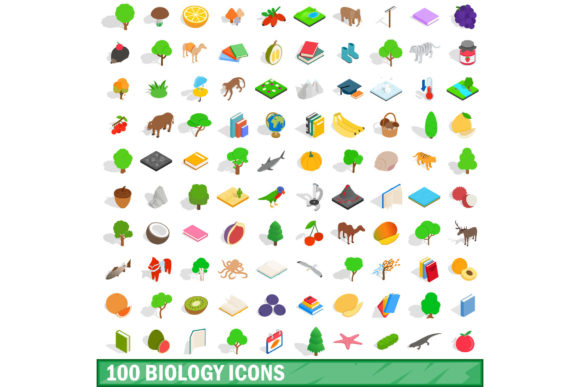
The Ultimate Guide to the 100 Biology Icons Set in Isometric 3D Style for Modern Design
In the rapidly evolving landscape of digital design, visual communication is paramount. Whether you are creating educational materials for a biology classroom, developing an interface for a health-tech application, or crafting marketing assets for a scientific conference, the quality and style of your graphics can make or break user engagement. This is where specialized asset libraries become indispensable tools for designers and developers. Among these resources, the 100 Biology Icons Set in Isometric 3D Style stands out as a premier collection designed to elevate any vector illustration project.
This comprehensive set offers more than just simple symbols; it provides a cohesive visual language that bridges the gap between complex scientific concepts and accessible, modern aesthetics. By combining the precision of vector graphics with the depth and realism of isometric 3D rendering, this collection allows creators to produce high-quality illustrations that are both informative and visually striking. In this article, we will explore what makes this icon set unique, how it fits into various professional workflows, and why mastering its use can significantly enhance your design portfolio.
Understanding Isometric 3D: Why It Matters in Science Communication
To appreciate the value of this specific icon set, one must first understand the design philosophy behind isometric 3D. Unlike traditional flat icons, which rely on minimalism and abstraction, isometric illustrations create a three-dimensional appearance using a fixed perspective. This technique avoids vanishing points, allowing objects to be measured directly from the drawing, which gives them a technical yet approachable feel.
In the context of biology and science, this style is particularly effective for several reasons:
- Clarity and Detail: Biological structures—such as DNA helices, cellular organelles, or molecular bonds—are inherently complex. A flat icon might oversimplify these structures, losing critical information. An isometric view allows designers to show depth, layers, and spatial relationships, making complex mechanisms easier to understand at a glance.
- Engagement: Human brains are wired to respond to depth cues. Isometric illustrations add a layer of visual interest that captures attention more effectively than standard 2D graphics. They feel tactile and substantial, inviting the viewer to look closer.
- Modern Aesthetic: The tech industry and modern startups have heavily favored isometric designs in recent years. Using this style signals that a brand or product is contemporary, innovative, and forward-thinking.
By adopting the 100 Biology Icons Set, designers leverage these psychological and aesthetic advantages without needing to model every single asset from scratch. The set ensures consistency across all elements, maintaining a uniform scale and lighting direction that creates a polished, professional look.
What’s Inside the Collection? A Deep Dive into the Assets
A set containing 100 biology icons is extensive, covering a wide spectrum of biological disciplines. This breadth ensures that whether you are designing for microbiology, genetics, ecology, or general anatomy, you will find relevant assets. The collection is curated to represent key themes in modern biological research and education.
Core Categories Included
- Cellular Biology: Detailed representations of cell structures, including mitochondria, nuclei, ribosomes, and cell membranes. These are essential for explaining basic life processes.
- Genetics and DNA: Visualizations of double helix structures, gene editing tools like CRISPR, and chromosomal arrangements. These icons help demystify the code of life.
- Molecular Structures: Various molecules, enzymes, and proteins rendered in 3D space. These are crucial for biochemistry and pharmaceutical design.
- Medical and Healthcare: Icons representing lab equipment (microscopes, petri dishes), medical procedures, and health monitoring devices. These bridge the gap between pure science and applied medicine.
- Ecology and Environment: Representations of ecosystems, plants, animals, and environmental factors like water cycles and carbon footprints. This category supports sustainability-focused designs.
Each icon is crafted with meticulous attention to detail. The isometric perspective ensures that even small details, such as the texture of a leaf or the structure of a virus capsid, are visible and distinct. This level of granularity is vital for educational content where accuracy matters.
Technical Versatility: Formats That Fit Your Workflow
One of the most significant advantages of this asset library is its technical flexibility. Designers work in diverse software environments, and compatibility is key to a smooth workflow. The 100 Biology Icons Set is available in multiple formats, ensuring seamless integration regardless of your preferred tool.
Vector Formats: AI, EPS, and PSD
The inclusion of AI (Adobe Illustrator), EPS (Encapsulated PostScript), and PSD (Photoshop Document) files is a game-changer for professional designers. Vector formats allow for infinite scalability without loss of quality. This means you can resize an icon from a tiny favicon to a large billboard print without pixelation.
- AI and EPS: Ideal for logo design, typography integration, and any project requiring precise editing of paths and shapes. You can easily change colors, adjust stroke widths, or combine different icons to create custom illustrations.
- PSD: For designers who prefer working with layers in Photoshop, the PSD files offer organized layer structures. This allows for non-destructive editing, enabling you to tweak shadows, highlights, and individual components of the 3D effect.
Raster Formats: JPG and PNG
While vectors are powerful, there are times when raster images are necessary, such as for web optimization or quick previews. The set includes JPG and PNG formats.
- PNG: With support for transparency, PNGs are perfect for overlaying icons on websites, presentations, or mobile app interfaces. They ensure that the background blends seamlessly with your design.
- JPG: Useful for final exports where file size needs to be minimized for faster loading times, though transparency is lost in this format.
Practical Applications Across Industries
The versatility of the 100 Biology Icons Set extends far beyond academic textbooks. Its applications span various sectors, reflecting the growing intersection of biology and technology.
Education and E-Learning
In the era of remote learning and digital classrooms, engaging visuals are critical for student retention. Teachers and curriculum developers can use these icons to create interactive slides, worksheets, and online quizzes. The 3D style helps students visualize abstract concepts, such as how a virus infects a cell or how photosynthesis works, leading to better comprehension and retention.
Health-Tech and Biotech Startups
Startups in the biotechnology and healthcare sectors often struggle to communicate their complex innovations to investors and consumers. High-quality isometric illustrations can simplify these narratives. For instance, a startup focusing on personalized medicine can use icons representing genetic sequencing and data analysis to create clear, compelling pitch decks and website hero sections.
Scientific Publishing and Journalism
Science communicators and journalists need to translate dense research papers into digestible content. Infographics are a primary tool for this purpose. The detailed nature of the isometric icons allows for rich, data-driven infographics that are both aesthetically pleasing and scientifically accurate.
User Interface (UI) and User Experience (UX) Design
For apps related to fitness, nutrition, or mental health, icons play a crucial role in navigation. Custom biology-themed icons can differentiate an app from competitors. The consistent style of the 100-icon set ensures that the UI remains cohesive, enhancing the overall user experience.
Common Misconceptions About 3D Icons
Despite their popularity, there are some misconceptions about using 3D-style icons in design projects.
Misconception 1: They Are Too Heavy for Web Use.
While 3D models can be resource-intensive, vector-based isometric icons (like those in the AI/EPS formats) are lightweight and scalable. Even raster versions can be optimized for web use without sacrificing visual quality. The key is choosing the right format for the right context.
Misconception 2: They Are Only for Tech Companies.
While tech companies favor isometric styles, the aesthetic is universal. Educational institutions, museums, hospitals, and environmental NGOs can all benefit from the clarity and professionalism that these icons provide. The "science" aspect of the design adds credibility to any organization dealing with health or nature.
Misconception 3: They Are Difficult to Customize.
On the contrary, because they are vector-based, they are highly customizable. Designers can alter colors to match brand guidelines, remove unnecessary details, or combine elements to create new, unique icons. This flexibility makes them a cost-effective solution compared to commissioning custom illustrations for every project.
Maximizing Value: Tips for Designers
To get the most out of the 100 Biology Icons Set in Isometric 3D Style, consider the following best practices:
- Maintain Consistency: Stick to the color palette and lighting direction provided in the set. Mixing isometric icons with flat or photorealistic elements can create visual dissonance.
- Leverage Layers: When working in PSD or AI, utilize the layered structure to experiment with compositions. Try overlapping icons to create depth and hierarchy.
- Contextualize: Don’t just place icons randomly. Use them to tell a story. For example, arrange icons in a sequence to depict a biological process, such as the lifecycle of a plant or the steps of DNA replication.
- Optimize for Export: Always export in the highest resolution possible for print, and compress appropriately for web use. Test your designs on different devices to ensure readability.
Conclusion
The 100 Biology Icons Set in Isometric 3D Style is more than just a collection of graphics; it is a powerful tool for effective communication. By combining scientific accuracy with modern design aesthetics, it enables creators to convey complex biological concepts in a way that is engaging, clear, and visually appealing. Whether you are an educator, a designer, a developer, or a scientist, integrating these assets into your workflow can significantly enhance the quality and impact of your visual content. Embrace the depth and detail of isometric design to bring your biological illustrations to life.